Meet Devon the Demon
 Devon Anne Dykiel copyright 2013
You have heard me mention my trainer Juliane numerous times, but I haven't told you how our friendship came to be. It is a friendship that includes her entire family and is integral to Devon's story. About ten years ago or so, I was riding my Andalusian mare Amada through woods abutting our property. I was ponying her adult son Navarro behind me, so my hands were full. Two hikers just ahead of me stepped off the path so I could go by. I stopped to thank them and learned they were from France. While we were talking I accidentally dropped Navarro's lead and the woman, who had introduced herself to me as Anne, competently picked it up and handed it back to me. A small thing, you say, but horse people are quick to notice details which indicate how familiar a person is with horses.
The Dykiels had been in the U.S. two years, and Anne was a horsewoman. She'd led horse treks through France. But with four children they found riding here prohibitively expensive. Unless you are well to do you cannot afford over eight hundred dollars a month so your four children can each ride for an hour. I told Anne that she could ride Amada out on the trail with me and that her children could visit my farm and meet our small pony Kip. They came that afternoon. One thing led to another and soon we were all riding out on the trail together. The two older children Hadrien and his sister Laurene took turns riding my Amada. At nine years old Juliane rode ten-hand Kip. Here are all four on a very tolerant Amada. It was her birthday and we decorated her with this silly chartreuse body paint. (All these children should have been wearing helmets, and I do apologize.)
 Amada with Dana, Laurene, Juliane and Hadrien Anne Dykiel copyright 2013
However, several months later poor Amada had to be euthanized at a veterinary hospital. Her intestine had ruptured. It was a difficult time for all of us, especially me, since she was my first horse, and I'd had her since she was four months old. There is not a day that goes by that I don't think of her. She was twenty-one.

Amada at 7 months (1982) and me at 33. Cornwall-on-Hudson
Without Amada I had no horse the Dykiels could ride regularly, so with their go-ahead I started to browse online for something inexpensive that might make a good family horse. I came across a Haflinger gelding who'd been abused, was difficult, and could be had for five hundred dollars. Of course, that description would give anyone pause, but the Dykiels were enthusiastic, talented, and eager to learn. And we would use a method employed successfully on every horse that had been on the farm. When I called Promised Land Farm in Virginia and said I was looking for a family horse, Danielle, the daughter of the owner, said Devon was unsuitable. But as we talked, and I explained some of our training methods, she and her mother Susan came around. I later learned that Susan's first response was, "No way. Is she out of her mind?!"
They sent us this photo of Devon:
 Devon Promised Land Farm copyright 2013
I was heartened. His eye, at least at that moment, looked quite soft, though the chain over his nose told me he probably was good at lugging his handlers around. In this shot his withers were lower than his croup but I thought that likely had to do with the slope of the hill. He looked decently built.
So one day a few weeks later, Susan, with Devon in her trailer, headed northeast from her farm in southwest Virginia and I headed southwest, empty trailer in tow. We met at the Penn National race track just north of Harrisburg, Pennsylvania: it was roughly halfway for both of us and had a huge parking lot, so there'd be plenty of room for our trailers, not to mention that Devon might be somewhat recalcitrant getting on mine.
Once Susan backed Devon off her trailer we let him stretch his legs and eat some grass along the chain link fence. No sign of a naughty horse yet. During the brief rest stop Susan told me more about what had happened to Devon in the three years of his life. Devon and his dam had been sold to two women at an auction. The dam had been worked hard by the Amish and was visibly lame from ringbone. Devon was five months old and still nursing. He'd had no handling and displayed moderate aggression at feeding time, pinning his ears and kicking out, but this was not directed at anyone, at least not yet. At six months, now weaned, but still too much for his inexperienced owners, he was sent to Danielle and Susan's Promised Land Farm for a month. There he was haltered and taught to lead. When stalled he continued to pin his ears at feeding time and kicked out. However, humans were still not an object of this unpleasant behavior.
Shortly after he was returned to the two women, things went from bad to worse. They hired a so-called trainer who hobbled Devon and forced him to the ground where he was compelled to lie for hours with a tarp draped over his entire body. This abusive training, torture really, could easily have destroyed this horse or led to his being put down.
Here is what is wrong about this. A horse should never be forced to lie on the ground for hours at a time. The sheer weight of his body mass can damage muscle. The lung that is lower may become so weighted that blood pools in it. When the horse gets back on his feet, he is likely to experience reperfusion. This occurs when the horse stands up and oxygenated blood rushes back to areas previously blocked by his weight. It can cause significant tissue damage.
Why was Devon hobbled and compelled to lie down? The owners and the man they hired seemed to believe it would make him more compliant. Hobbles took away his ability to flee while forcing him to the ground. It surely terrified him. It was a barbarous act of cruelty. As a prey animal the last place a horse wants to be is lying flat out on the ground. I am not at all against teaching a horse to lie down. A trainer whose horse willingly lies flat on the ground for her is a trainer who has an animal who trusts her and believes his environment to be safe. A long and gentle process involving much ground training, it is a beautiful thing to see.
Some horses who experience the so-called training that Devon suffered have a passive reaction. They become little more than the walking dead. Robbed of their dignity, the light goes out in their eyes, for life is just something to be silently endured. But as with other horses, it caused Devon--and remember, he was only six months old--utterly to hate people. He'd been robbed of a horse's first instinct, which is to flee. All he had left was the second, the instinct to fight. And this he soon did with an abiding fury.
At this point his fearful owners asked Susan and Danielle to take him, and they did. Neither woman yet knew how badly his abuse had been. Back at Promised Land, Devon's aggressive ways continued. He bit or tried to bite anyone who came near his pasture fence line. If someone went in to get him, he would spin his hindquarters in their direction attempting to kick them. Danielle told me that in an unguarded moment he bit her in the stomach as she entered his stall.
But who could blame him? Those who offend have often been much offended. Danielle and Susan knew why this six-month-old had turned into the horse that everyone now called Devon the Demon. (I learned of that appellation a year later.) They are both skilled horsewomen, but by this time Devon was so angry, so emotionally damaged, that after a year of trying to help him they determined that he needed some specialized attention. He was unpleasant to have around, and they were afraid he might seriously injure someone. As Devon obediently walked onto my trailer, tears ran down Susan's cheeks. He may have tried to kick and bite her, but she loved him.
By the time I got home I'd driven sixteen hours. Devon and I were exhausted so we both got the next day off. But then work began in earnest. When I entered his stall he pinned his ears. He tried to bite me as I approached with his halter. I gave him a sharp jab in the jowl and slid the halter on. I then stroked the part of his cheek I had struck, a necessary step which prevents a horse from becoming head shy after such a strong correction. I could not permit Devon to establish himself as herd leader at Windflower, at least not among the humans. I immediately led him to the round pen. There he learned that I and my lunge whip would determine whether he walked, trotted, cantered and where and when he would change direction. However, this didn't prevent him from fleeing. If he wanted to leave he could, albeit within the confines of a sixty-foot round pen.
Initially, he kicked out a lot, frequently threatening to come in and trample me, but I was always able to drive him forward. I didn't step back or retreat once. In the past when Devon came at people, they understandably parted like the Red Sea. Handlers make this mistake often and unconsciously. They don't realize that they are communicating to their horses as subordinates. Even taking a step back from a horse with a dominant nature or poor training can lead to problems. And if you are feeding him it can compound the problem. As he aggressively pushes on the apple you are holding and forces you to step back in order to keep your balance, you are likely relaying that you have yielded your food and personal space to him.
That Devon was out of shape worked to our advantage. After about fifteen minutes or so of trotting and cantering the bucking gradually subsided, and he no longer kicked out when asked to change direction. His narrowed eyes opened and became soft. He cocked a listening ear toward me, all signs that he was seriously thinking about abdicating his self-appointed position as Emperor of Windflower Farm.
 Not Mr. Tough Guy Here Anne Dykiel copyright 2013
When his tightened muzzle relaxed, and he started to chew with his mouth softly, I relaxed my erect body posture, let go of the whip, and beckoned him to come in to me. This he did. Had his expression hardened in any way as he came toward me, I would have sent him off for another few rounds in the pen. I spoke softly, stroking him all over. (Remember Amalia's Mother Strokes?) After several attempts he "joined-up" with me. That is, when I walked away from him he followed. Remember, there is no lead attached. As I turned, he turned; when I ran he ran, and when I stopped he stopped. He had yielded and accepted me as his herd leader.
But with Devon, as with many dominant horses, such acceptance was transitory. Again and again I had to establish my authority, not only in the round pen but at feeding time. When I carried hay out the pasture, I always carried a dressage whip or Natural Horsemanship stick, a four-foot length of durable plastic with five foot lash attached. It wasn't because I thought he would attack me--we'd gotten past that--but I wasn't going to let him pin his ears or lift a hind leg in a threatening manner. I would send him off and claim the pile of hay that he had been eating as my own. This is exactly what happens in a herd, be it one of wild or domestic horses. The dominant horse decides which area of grass or flake of hay he wants and drives his competitors away.
Here is Devon waiting to be brought in for dinner. He's exhibiting some impatience by standing on my fence boards (grrrr!), but I like his expression:
 Devon on Fence Boards Ainslie Sheridan copyright 2013
The Dykiels and I continued our Natural Horsemanship program for the next several weeks. Slowly Devon's aggressive posturing subsided. It was now time to back him. Again, this was done by using the Natural Horsemanship method of Clinton Anderson, though we did modify it somewhat. Like all the other horses we've started this way, Devon responded very well. Any horse easily and naturally comprehends training that incorporates the use of herd dynamics. It's in their DNA. This method made Devon more certain of his environment and greatly increased his security.
The first day Devon was turned out with the other horses he immediately established himself as herd leader. Every one of my horses yielded to his blustery authority. Secure in his position he then felt free to engage in play for the first time in his life. (The following pictures are here copyright 2013 but were taken almost ten years ago.)
 Devon and Rodrigo Ainslie Sheridan copyright 2013
 Devon and Rodrigo Anne Dykiel copyright 2013


Devon and Rodrigo Anne Dykiel copyright 2013
 Devon and Rodrigo Anne Dykiel copyright 2013
 Who's got possession of the ball? Anne Dykiel copyright 2013
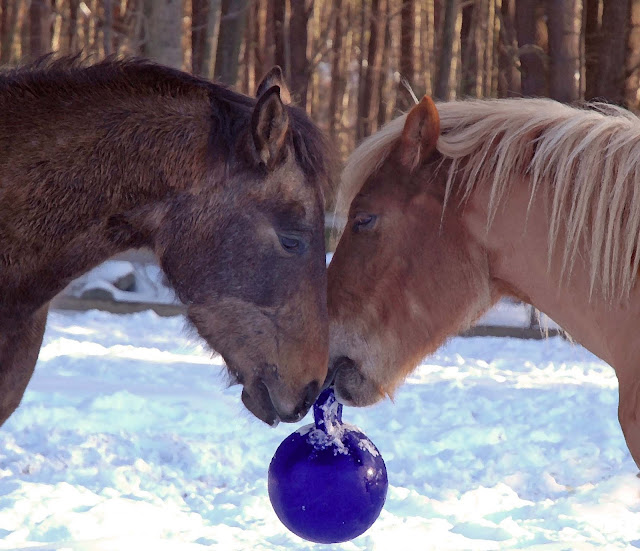 Devon Has Possession Anne Dykiel copyright 2013
Here with our two newly arrived Haflingers from Promised Land Farm, Madeo and Forest:
 Devon, Madeo and Forest Anne Dykiel copyright 2013
And now his human family, the incredible Dykiels:
 Devon with (left to right) Hadrien, Laurene Hummer copyright 2013
little Dana, Richard, and Anne
 Devon with nine-year-old Juliane Anne Dykiel copyright 2013
Next, Devon's first outing on the trail. He is crossing a riverbed with Hadrien You can tell by his expression and soft eye that Devon is enjoying himself.
 Devon and Hadrien Ainslie Sheridan copyright 2013
Notice that Devon is in a D-ring snaffle and there's slack in the reins. All horses naturally pull against pressure to get away, but we teach them that won't work. While holding one rein the rider pulls the horse's head to the side, keeping constant pressure on the rein. When the horse gives even the tiniest bit of pressure on the rein, then that rein is immediately released. This is done many times on both sides until the horse is soft on both sides and immediately yields even before he feels any pressure. At a lot of other farms hard-mouthed horses often find themselves immediately out of a snaffle and into a harsher bit. That may work for a while but it's often temporary. Then it's on to an even more severe bit. The cycle is repeated and escalated.
With Laurene Dykiel:
 Laurene and Devon Anne Dykiel copyright 2013
 Laurene and Devon Anne Dykiel copyright 2013
Anne Dykiel with a sweet, relaxed horse:
 Devon and Anne Laurene Hummer copyright 2013
Devon enjoying a shower from then nine-year-old Juliane:
 Devon and Juliane Anne Dykiel copyright 2013
Devon had three lovely gaits. Here he is on the dressage arena:
 Devon Anne Dykiel copyright 2013
And we soon discovered he could really jump!
 Hadrien and Devon Ainslie Sheridan copyright 2013
A Winner!
 Blue ribbon winners Hadrien and Devon Anne Dykiel copyright 2013
During his stay at Windflower Farm we all learned a lot from Devon. He became so reliable that we were able to put a number of our beginner students on him. He is, by nature, a dominant fellow but that, in the end, is what saved him. Those who treated him so badly had been unable to deal with his rage. The Dykiels rode him in local shows, on trails, and at the beach for long gallops through tidal pools and along the sand. In the pasture he was always turned out with the other horses. I often saw him lying flat out on my dressage arena enjoying naps on the sun-warmed sand. And we knew he would never find himself in the equine equivalent of Purgatory again.
The stars had finally lined up in Devon's favor. Stay tuned for Part Two, and the story of the remarkable partnership with a new owner.
Thank you reading The Windflower Weekly. See you soon!
-- Ainslie
Links:
http://www.rubysvoiceequine.com/index.asp
planimalrescue@yahoo.com (This is for Promised Land Farm Rescue if you care to make a donation.)

You have heard me mention my trainer Juliane numerous times, but I haven't told you how our friendship came to be. It is a friendship that includes her entire family and is integral to Devon's story. About ten years ago or so, I was riding my Andalusian mare Amada through woods abutting our property. I was ponying her adult son Navarro behind me, so my hands were full. Two hikers just ahead of me stepped off the path so I could go by. I stopped to thank them and learned they were from France. While we were talking I accidentally dropped Navarro's lead and the woman, who had introduced herself to me as Anne, competently picked it up and handed it back to me. A small thing, you say, but horse people are quick to notice details which indicate how familiar a person is with horses.
The Dykiels had been in the U.S. two years, and Anne was a horsewoman. She'd led horse treks through France. But with four children they found riding here prohibitively expensive. Unless you are well to do you cannot afford over eight hundred dollars a month so your four children can each ride for an hour. I told Anne that she could ride Amada out on the trail with me and that her children could visit my farm and meet our small pony Kip. They came that afternoon. One thing led to another and soon we were all riding out on the trail together. The two older children Hadrien and his sister Laurene took turns riding my Amada. At nine years old Juliane rode ten-hand Kip. Here are all four on a very tolerant Amada. It was her birthday and we decorated her with this silly chartreuse body paint. (All these children should have been wearing helmets, and I do apologize.)

However, several months later poor Amada had to be euthanized at a veterinary hospital. Her intestine had ruptured. It was a difficult time for all of us, especially me, since she was my first horse, and I'd had her since she was four months old. There is not a day that goes by that I don't think of her. She was twenty-one.

Amada at 7 months (1982) and me at 33. Cornwall-on-Hudson
Without Amada I had no horse the Dykiels could ride regularly, so with their go-ahead I started to browse online for something inexpensive that might make a good family horse. I came across a Haflinger gelding who'd been abused, was difficult, and could be had for five hundred dollars. Of course, that description would give anyone pause, but the Dykiels were enthusiastic, talented, and eager to learn. And we would use a method employed successfully on every horse that had been on the farm. When I called Promised Land Farm in Virginia and said I was looking for a family horse, Danielle, the daughter of the owner, said Devon was unsuitable. But as we talked, and I explained some of our training methods, she and her mother Susan came around. I later learned that Susan's first response was, "No way. Is she out of her mind?!"
They sent us this photo of Devon:

I was heartened. His eye, at least at that moment, looked quite soft, though the chain over his nose told me he probably was good at lugging his handlers around. In this shot his withers were lower than his croup but I thought that likely had to do with the slope of the hill. He looked decently built.
So one day a few weeks later, Susan, with Devon in her trailer, headed northeast from her farm in southwest Virginia and I headed southwest, empty trailer in tow. We met at the Penn National race track just north of Harrisburg, Pennsylvania: it was roughly halfway for both of us and had a huge parking lot, so there'd be plenty of room for our trailers, not to mention that Devon might be somewhat recalcitrant getting on mine.
Once Susan backed Devon off her trailer we let him stretch his legs and eat some grass along the chain link fence. No sign of a naughty horse yet. During the brief rest stop Susan told me more about what had happened to Devon in the three years of his life. Devon and his dam had been sold to two women at an auction. The dam had been worked hard by the Amish and was visibly lame from ringbone. Devon was five months old and still nursing. He'd had no handling and displayed moderate aggression at feeding time, pinning his ears and kicking out, but this was not directed at anyone, at least not yet. At six months, now weaned, but still too much for his inexperienced owners, he was sent to Danielle and Susan's Promised Land Farm for a month. There he was haltered and taught to lead. When stalled he continued to pin his ears at feeding time and kicked out. However, humans were still not an object of this unpleasant behavior.
Shortly after he was returned to the two women, things went from bad to worse. They hired a so-called trainer who hobbled Devon and forced him to the ground where he was compelled to lie for hours with a tarp draped over his entire body. This abusive training, torture really, could easily have destroyed this horse or led to his being put down.
Here is what is wrong about this. A horse should never be forced to lie on the ground for hours at a time. The sheer weight of his body mass can damage muscle. The lung that is lower may become so weighted that blood pools in it. When the horse gets back on his feet, he is likely to experience reperfusion. This occurs when the horse stands up and oxygenated blood rushes back to areas previously blocked by his weight. It can cause significant tissue damage.
Why was Devon hobbled and compelled to lie down? The owners and the man they hired seemed to believe it would make him more compliant. Hobbles took away his ability to flee while forcing him to the ground. It surely terrified him. It was a barbarous act of cruelty. As a prey animal the last place a horse wants to be is lying flat out on the ground. I am not at all against teaching a horse to lie down. A trainer whose horse willingly lies flat on the ground for her is a trainer who has an animal who trusts her and believes his environment to be safe. A long and gentle process involving much ground training, it is a beautiful thing to see.
Some horses who experience the so-called training that Devon suffered have a passive reaction. They become little more than the walking dead. Robbed of their dignity, the light goes out in their eyes, for life is just something to be silently endured. But as with other horses, it caused Devon--and remember, he was only six months old--utterly to hate people. He'd been robbed of a horse's first instinct, which is to flee. All he had left was the second, the instinct to fight. And this he soon did with an abiding fury.
At this point his fearful owners asked Susan and Danielle to take him, and they did. Neither woman yet knew how badly his abuse had been. Back at Promised Land, Devon's aggressive ways continued. He bit or tried to bite anyone who came near his pasture fence line. If someone went in to get him, he would spin his hindquarters in their direction attempting to kick them. Danielle told me that in an unguarded moment he bit her in the stomach as she entered his stall.
But who could blame him? Those who offend have often been much offended. Danielle and Susan knew why this six-month-old had turned into the horse that everyone now called Devon the Demon. (I learned of that appellation a year later.) They are both skilled horsewomen, but by this time Devon was so angry, so emotionally damaged, that after a year of trying to help him they determined that he needed some specialized attention. He was unpleasant to have around, and they were afraid he might seriously injure someone. As Devon obediently walked onto my trailer, tears ran down Susan's cheeks. He may have tried to kick and bite her, but she loved him.
By the time I got home I'd driven sixteen hours. Devon and I were exhausted so we both got the next day off. But then work began in earnest. When I entered his stall he pinned his ears. He tried to bite me as I approached with his halter. I gave him a sharp jab in the jowl and slid the halter on. I then stroked the part of his cheek I had struck, a necessary step which prevents a horse from becoming head shy after such a strong correction. I could not permit Devon to establish himself as herd leader at Windflower, at least not among the humans. I immediately led him to the round pen. There he learned that I and my lunge whip would determine whether he walked, trotted, cantered and where and when he would change direction. However, this didn't prevent him from fleeing. If he wanted to leave he could, albeit within the confines of a sixty-foot round pen.
Initially, he kicked out a lot, frequently threatening to come in and trample me, but I was always able to drive him forward. I didn't step back or retreat once. In the past when Devon came at people, they understandably parted like the Red Sea. Handlers make this mistake often and unconsciously. They don't realize that they are communicating to their horses as subordinates. Even taking a step back from a horse with a dominant nature or poor training can lead to problems. And if you are feeding him it can compound the problem. As he aggressively pushes on the apple you are holding and forces you to step back in order to keep your balance, you are likely relaying that you have yielded your food and personal space to him.
That Devon was out of shape worked to our advantage. After about fifteen minutes or so of trotting and cantering the bucking gradually subsided, and he no longer kicked out when asked to change direction. His narrowed eyes opened and became soft. He cocked a listening ear toward me, all signs that he was seriously thinking about abdicating his self-appointed position as Emperor of Windflower Farm.

When his tightened muzzle relaxed, and he started to chew with his mouth softly, I relaxed my erect body posture, let go of the whip, and beckoned him to come in to me. This he did. Had his expression hardened in any way as he came toward me, I would have sent him off for another few rounds in the pen. I spoke softly, stroking him all over. (Remember Amalia's Mother Strokes?) After several attempts he "joined-up" with me. That is, when I walked away from him he followed. Remember, there is no lead attached. As I turned, he turned; when I ran he ran, and when I stopped he stopped. He had yielded and accepted me as his herd leader.
But with Devon, as with many dominant horses, such acceptance was transitory. Again and again I had to establish my authority, not only in the round pen but at feeding time. When I carried hay out the pasture, I always carried a dressage whip or Natural Horsemanship stick, a four-foot length of durable plastic with five foot lash attached. It wasn't because I thought he would attack me--we'd gotten past that--but I wasn't going to let him pin his ears or lift a hind leg in a threatening manner. I would send him off and claim the pile of hay that he had been eating as my own. This is exactly what happens in a herd, be it one of wild or domestic horses. The dominant horse decides which area of grass or flake of hay he wants and drives his competitors away.
Here is Devon waiting to be brought in for dinner. He's exhibiting some impatience by standing on my fence boards (grrrr!), but I like his expression:

The Dykiels and I continued our Natural Horsemanship program for the next several weeks. Slowly Devon's aggressive posturing subsided. It was now time to back him. Again, this was done by using the Natural Horsemanship method of Clinton Anderson, though we did modify it somewhat. Like all the other horses we've started this way, Devon responded very well. Any horse easily and naturally comprehends training that incorporates the use of herd dynamics. It's in their DNA. This method made Devon more certain of his environment and greatly increased his security.
The first day Devon was turned out with the other horses he immediately established himself as herd leader. Every one of my horses yielded to his blustery authority. Secure in his position he then felt free to engage in play for the first time in his life. (The following pictures are here copyright 2013 but were taken almost ten years ago.)


Devon and Rodrigo Anne Dykiel copyright 2013

Devon and Rodrigo Anne Dykiel copyright 2013

Devon and Rodrigo Anne Dykiel copyright 2013


Here with our two newly arrived Haflingers from Promised Land Farm, Madeo and Forest:

And now his human family, the incredible Dykiels:

little Dana, Richard, and Anne

Next, Devon's first outing on the trail. He is crossing a riverbed with Hadrien You can tell by his expression and soft eye that Devon is enjoying himself.

Notice that Devon is in a D-ring snaffle and there's slack in the reins. All horses naturally pull against pressure to get away, but we teach them that won't work. While holding one rein the rider pulls the horse's head to the side, keeping constant pressure on the rein. When the horse gives even the tiniest bit of pressure on the rein, then that rein is immediately released. This is done many times on both sides until the horse is soft on both sides and immediately yields even before he feels any pressure. At a lot of other farms hard-mouthed horses often find themselves immediately out of a snaffle and into a harsher bit. That may work for a while but it's often temporary. Then it's on to an even more severe bit. The cycle is repeated and escalated.
With Laurene Dykiel:


Anne Dykiel with a sweet, relaxed horse:

Devon enjoying a shower from then nine-year-old Juliane:

Devon had three lovely gaits. Here he is on the dressage arena:

And we soon discovered he could really jump!

A Winner!

During his stay at Windflower Farm we all learned a lot from Devon. He became so reliable that we were able to put a number of our beginner students on him. He is, by nature, a dominant fellow but that, in the end, is what saved him. Those who treated him so badly had been unable to deal with his rage. The Dykiels rode him in local shows, on trails, and at the beach for long gallops through tidal pools and along the sand. In the pasture he was always turned out with the other horses. I often saw him lying flat out on my dressage arena enjoying naps on the sun-warmed sand. And we knew he would never find himself in the equine equivalent of Purgatory again.
The stars had finally lined up in Devon's favor. Stay tuned for Part Two, and the story of the remarkable partnership with a new owner.
Thank you reading The Windflower Weekly. See you soon!
-- Ainslie
Links:
http://www.amazon.com/Trophies-An-Equestrian-Romance-ebook/dp/B00998J2B2
http://www.barnesandnoble.com/w/the-kaleidoscope-pony-ainslie-sheridan/1114272809?ean=2940015948592
http://www.allhorsestuff.com/
http://www.facebook.com/YonkersShelter
http://www.saveyourassrescue.org/foradoption.html
planimalrescue@yahoo.com (This is for Promised Land Farm Rescue if you care to make a donation.)


