Monday, May 26, 2014

The Kindness of a Stranger, White Horses Save!, Coyote Encounters, Glass Box Lights For Horse Lovers


       The Kindness of a Stranger


      On Sunday afternoons when the weather was nice, my father often took my brothers and me on hikes at the various parks, arboretums, and beaches on Long Island.  One day we went to  West Hills County Park in Suffolk County, a conservation area known for its lovely trails.

       As we stood on High Hill, reputedly Long Island's highest at an underwhelming four hundred feet, a woman emerged from the wood.  She was riding what to me seemed the most beautiful horse in the world.  (You can see that he wasn't even close.)  His name was Major, and when I told the woman that I loved horses, she picked me up as if I weighed no more than a leaf, and placed me in the saddle.

       There I was, a little girl laid low from years of abuse at the hands of my father, now seated on a giant of a horse standing on the highest hill on Long Island.  For those few moments I was the tallest person on Long Island, taller even than my father. 

       I don't know if I ever knew the woman's name, but I do remember her as beautiful.  Her jacket, breeches, and hair ribbon were all a matching forest green.  How I wish I could tell this woman what she had done for me that day.  For me it was so much more than a simple act of kindness.  She'd lifted me up and placed me on a living throne.  Until then such a moment had seemed as out of reach as the gold ring my extended hand failed to grasp when I rode the white Merry-Go-Round horses at Nunley's Happyland. 


        "White Horses Save"

       One Christmas Eve, nearly fifty years later, I received a wonderful and touching gift from my husband Jim Engell.  He knew all about my childhood, indeed, and when I started remembering long repressed memories, he was at my side with love and support.  Aware of the symbolic importance that horses, especially white horses, held for me, he presented my with this poem:


       "God's Dog," the Coyote   (Part One)

       That's how southwestern Native American tribes reverentially refer to the coyote.  For the past twenty-one years I've had a number of chance encounters with the Eastern coyote.  Larger than it's western cousin, it's now thought to be a wolf-coyote hybrid that a number of biologists and naturalists believe should more accurately be called the Eastern coy-wolf.  The theory is that when farmers in the northeast nearly eradicated the red wolf, the few that remained mated with the next best thing--coyotes.  The wolf-like characteristics seem to vary in the coyotes I have seen, but they are definitely apparent.

       Here is one bold fellow surveying my pasture with equanimity.  Taking into consideration the dimensions of his surroundings, he seemed at least forty pounds.  (The Western coyote averages 15-35 lbs.)


    Eastern coyote (Coywolf), Acton, MA                                Ainslie Sheridan copyright 2014

      Here is a different coyote, also more wolf-like than his western cousin:

                     Eastern coyote, Acton, MA                        Ainslie Sheridan copyright 2014


       The majority of my sightings have occurred not on our small farm but while riding my horse in the conservation areas and private riding trails that abut our property.  On those occasions I usually traveled in the company of one or two medium- or large-sized dogs.  When we were spotted, the coyotes would disappear quickly into the underbrush, wanting absolutely nothing to do with me and my entourage.  One winter, when I rode without dogs, I happened on a pair walking along the trail ahead of me.  When they saw me, they started to trot ahead but didn't seem terribly worried.  They glanced back over their shoulders but more out of curiosity.  I lost sight of them after they crossed a frozen pond and disappeared into the woods.  

       Over the years I've seen a variety of colors from the typical gray with touches of brown, to a light cinnamon (almost yellow) to a stunning all black one.  I'd never seen hide nor hair of a pup until last year.  It was July and the pouring rain put a temporary stop to the voracious deer  flies.  Accompanied by three dogs this time, as I came out of a wooded trail into a small field, I saw him, a pup certainly no more than four months old.  He took off pursued by the dogs.  I got off Elementa who was dancing around and thinking of bolting.  Miraculously, the dogs came back when I called, not right away, but in a minute or two.  We must have given the little thing a fright.

       The sliding glass doors of our family room look directly out onto our pasture.  Over the years I've seen foxes, turkeys, deer, snapping turtles (they come to lay eggs in my sandy dressage arena), as well as coyotes.  Though the coyote encounters at my farm have been fewer in number than those in the woods, they've been longer.  Why?  Food, I think.  Those of you who have been around horses know how dogs love manure.   Coyotes are no different.  They are also drawn to leftover grains of feed, mice, those buried snapping turtle eggs, and, of course, my one duck, my one chicken, and my one rabbit.  Depending on the time of year, I've seen them in the pasture lying under the shade a tree, or sunning themselves in the soft comfort of my dressage arena.

       At night we sometimes hear a howling coyote chorus of such stereophonic volume it feels as if the sounds are coming out of our very own bones.  When I first heard it I was certain there had be a large pack right under our window.  But, no, they were nowhere in sight.  Also, coyotes are capable of what is called "the beau geste," an auditory illusion created by a single coyote's ability to emit multiple sounds that can become distorted as they travel through the environment.  You might think you are hearing ten coyotes, but it is probably just two, maybe three.

       Just as wolves have had to endure centuries of uninformed bigotry and aggression, so, too, has the coyote.  What twenty-one years of living at Windflower Farm has taught me is that coyotes would much rather run than fight.  The number of invectives directed towards them run from unfair to chilling.  They are regularly referred to as vermin and pests, with men of "a certain age" calling them "Charlie."  For those of you too young to remember, that is what US troops in Vietnam called the Viet Cong, our enemy at the time.  Milder forms of uninformed bias simply assume that people are under threat by coyotes even when the animals are moving in the opposite direction.

      Coyotes mate for life, though that life is often harsh and short.  Litter size is usually six but can be as few as one or as many as nineteen.  Only five to twenty percent survive to adulthood.  The mother stays in her den with her pups for nearly five weeks, not allowing any other family members in.  She lives on food her mate brings to her.  When the period of nursing is over, she feeds her pups by regurgitating food into their mouths.  The father and an aunt or uncle, usually members of a previous litter, all help in raising the pups.  They are also known to adopt pups of a litter whose parents have been killed.  

      Hunters complain that coyotes decimate the deer population, but coyotes, like wolves, generally attack the small, the weak, and the sick.  It is the human trophy hunters--those who want the biggest buck with the most points--who endanger the deer population by depriving them of their strongest members.  And then there are those who seem to think coyotes must spend their nights dreaming how to attack and dispatch humans and must, therefore, be eradicated.  In the United States in 2013 deaths from homicides was 263, 260.  Death from coyote attacks that same year--zero!

       Coyotes perform a vital function for farmers and ranchers by keeping rodent and insect populations under control.  If coyotes turn to sheep, it's often because the land the sheep are on has been overgrazed and can no longer sustain a viable rodent population.  One rancher in Washington state moved his stock to different pastures before they became overgrazed and incurred no losses due to coyote predation.  Farmers and ranchers are also less inclined to use breeds of dogs that the Europeans have for centuries to protect their sheep and goats--the Kommodor, Kuvasz, Anatolian, and the Great Pyrenees, for example.  There has been some success with donkeys and llamas, but the deterrent of choice in our good ol' USA remains a gun.

       Coyotes are usually shy animals and will almost always retreat rather than fight.  There is, however, one caveat:  when  coyotes believe that their pups are threatened, they will do what they think necessary to protect them.  Two days ago, while on a ride on my horse Elementa, and with our dog Clem and our neighbor's dog Lucky, I unintentionally became that threat.  I've never in my adult life encountered such ferocity, nor felt so terrified.  Stay tuned for Part Two:  When Coyotes Choose Fight Over Flight."


Glass Light Boxes

  Sleep Magic                                                                    Ainslie Sheridan copyright 2014

       I have always been searching for alternatives to the usual picture frame to display my images.  The above is a copy of hand-colored photograph I took of my Andalusian Navarro (now  owned by a dear friend).  The glass blocks are 8"x8"x3".  These have an opening at the bottom which allows me to insert the photograph as well as a short strand of toile-wrapped holiday lights.  These backlight the photo to give it a three-dimensional effect.  Here are a few more examples of horses:


      On to Cats:


 Dog (in future more to come):

       I collect Victorian images and this is one of child and dog captured my heart:


       Flowers

       With the exception of the poppy and alium garden photo, I took these in a friend's Concord garden.


       Upon seeing the finished product, a well known crafter urged me to sell them as gifts.  So, in my never-ending quest to pay my yearly horse show fees, I am in the process of opening a store on Etsy, an e-commerce site that focuses on vintage and handmade items.  The light boxes look wonderful on mantle, countertop, or bookshelf and make a comforting nightlight for adults or children.  I have one in my bathroom, which saves me from having to switch on the overheard light.

       They are currently selling for $25.00 plus shipping and handling.  Each one is assembled by hand.

       I will post my online Etsy shop shortly, but if any of my readers want a light box now, please contact me via e-mail:  sheridanstudio@gmail.com 

      I promise the next blog entry will be within a week.  There is lots going on here.  Next week I am taking on of my students to a hunter pace, the next to a horse show.  There is a huge patch of dirt in my backyard begging me not to forget my promise to turn it into a garden before weeds overtake it, again!  

Thank you for reading The Windflower Weekly, and I will see you soon--

Ainslie

Sources:


http://www.coyotelivesinmaine.com/coyote/2014/03/08/listening-to-the-songdogs/
http://www.amazon.com/Gods-Dog-Celebration-American-Coyote/dp/0595350364/ref=sr_1_2?s=books&ie=UTF8&qid=1401102667&sr=1-2&keywords=God%27s+Dog
http://www.statista.com/statistics/195331/number-of-murders-in-the-us-by-state/


Links You Might Like:
 
 http://www.cafepress.com
http://www.amazon.com/Trophies-An-Equestrian-Romance-ebook/dp/B00998J2B2
http://www.barnesandnoble.com/w/the-kaleidoscope-pony-ainslie-sheridan/1114272809?ean=2940015948592
http://www.allhorsestuff.com/
http://www.facebook.com/YonkersShelter
http://www.saveyourassrescue.org/foradoption.html


Friday, February 14, 2014

Snow Play For The Ponies and When Good Horse Go Bad


 The Snow Must Go On!

       At least that's what Mother Nature is telling us.  Just when I was beginning to see traces of my dressage arena, enter snow storm Nika!  Another ten plus inches.  And another twelve added by storm Pax. Fortunately, I'm still able to use my large front paddock.  The plow comes in, pushes everything to the side, and then I take my trusty snow shovel--it's the kind skaters use to clear snow off their ponds--and level it some more.  Since the days are getting longer and the sun stronger, the snow melts fairly quickly.  Most of our students would be happy just to take galloping snow rides on the trail, but we've got to strike a balance for a couple of reasons.  First, the horses really shouldn't go out in deep footing for more than one lesson.  We can't risk the possibility of pulled or torn ligaments.  Second, we need to continue to work on horsemanship, proper core alignment, balance, and communication. 

    Here's Elementa in the front paddock just after the plow came through.  She is doing a great job with her own natural balance and alignment:


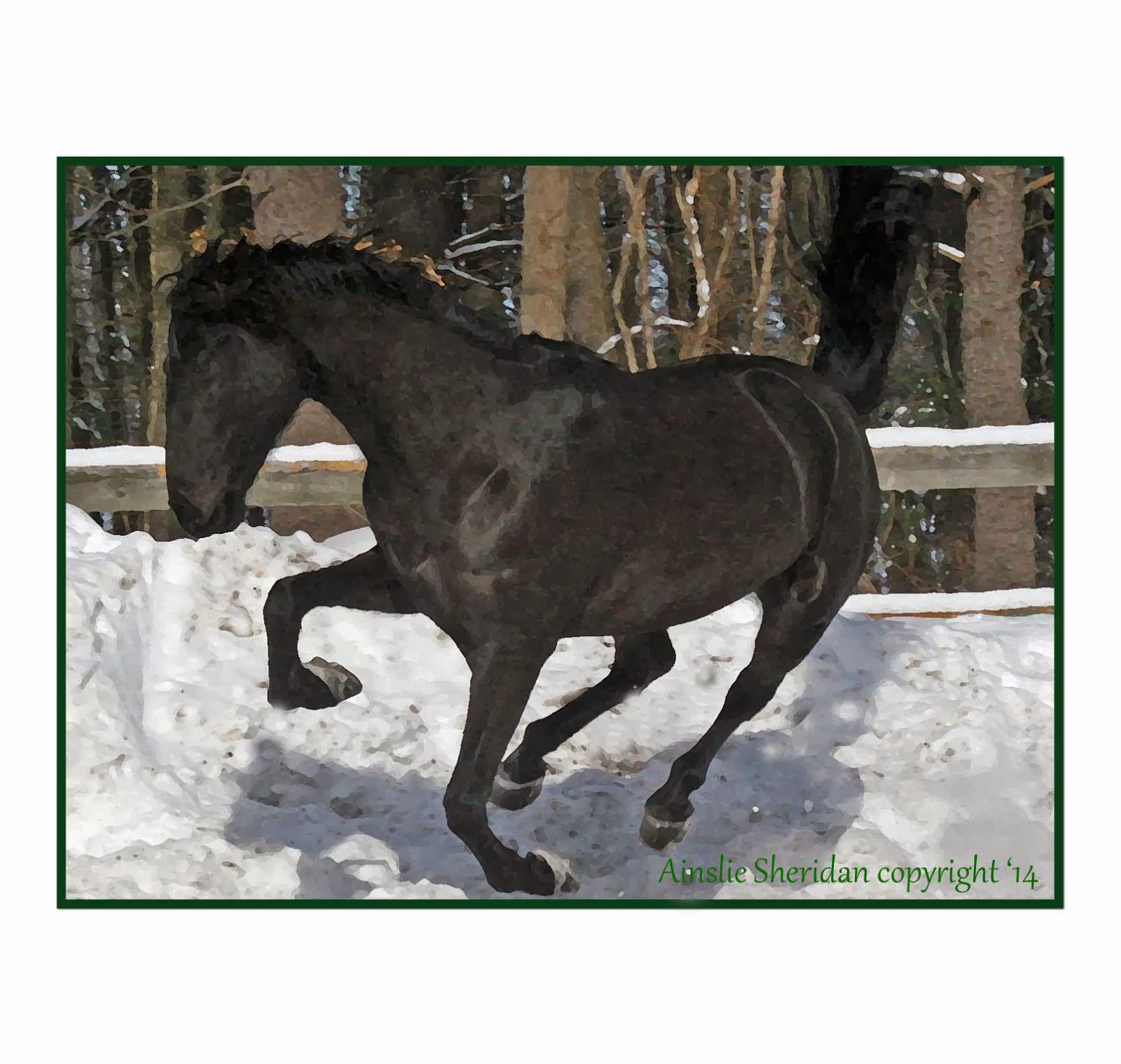
         But then sometimes, like my students (and me), you just gotta kick it:


      Onto the more sedate Dolly:


If you don't think horses have a sense of humor, take a close look at Dolly below.  I think that's smirk.


          I should have said, " . . . the 'usually' more sedate Dolly":


        If you look closely at the above you will see why we think Dolly either gave birth to a foal or miscarried very late in her pregnancy.  You can see the enlarged nipple.   If she hadn't had a nursing foal, at the very least she once had an udder full of milk.  I will never know what happened that terribly painful and, perhaps, sad day for Dolly. 

       Here taking a sun snooze--no pain, no sadness--just warmth and contentment:


       Here is the only reasonable shot I took of Firefly.  Her mane and tail were dirty, so not much was fit for publication.  In this shot, her normally glorious coif is thankfully on the other side of her neck, and I simply cropped out her tail:

                Firefly                                                                               Ainslie Sheridan copyright 2014 


       The Lessons Must Go On!

       I have been remiss in not blogging enough about my students, but I'm going to make amends right now.   You last met Caitlin when she went to the Cutter Farm horse show a couple of months ago on our little ten hand Kip.  Here she is more recently:

         This was taken last Saturday and, as you can see, we're not lacking in snow.  The question was how to teach Caitlin, an intermediate rider.  I couldn't take her out on the trails because I already planned to take Elementa out with two other students.  A third time in this snow would be too much.  Caitlin and I decided the best thing would be for her to go bareback.  I sent her out onto a trail by herself, though she was always in sight.  Her job was then to keep Kip at halt until I called them.  Then she was free to trot, canter, gallop and gallop back, whatever she wished.  This took quite a bit of skill, particularly since she was bareback.  Kip was not inclined to turn around and head back out on the trail,  nor was Kip eager to halt until I called, but Caitlin handled all this very well, as you see in the above photo.

             Next lesson was with Jenna, who's been riding at Windflower since she was eight.  Here she is at about age eleven:


      Kip and Jenna                                                                        Ainslie  Sheridan copyright 2014


       And here she is at sixteen, just six days ago, flying around the dressage arena--yes, it is there under the snow somewhere--on Firefly:

  
       Jenna's lesson started with lungeing Firefly in the snow.  This she did for two reasons:  first, it was cold and it really wouldn't have been in Firefly's best interest to toss an adolescent up on her back and immediately get her going in trot and canter.  Why couldn't Jenna just get on an warm Firefly up at the walk, you ask?
A reasonable question, which brings us to the second reason:  Firefly--as you can deduce from the picture above--is an energetic lady and would have declined to keep herself at walk. 

       Katie was next up on Quilly.  Like Jenna, Katie has been at Windflower eight years.  Here's a picture taken when she was thirteen:

       Snap, Katie, and Firefly                                                                                Ainslie Sheridan copyright 2014


          And six days ago on Quilly, our Welsh pony: 

 
        As you can see, Katie rides well, and though Quilly's ears are back, it is not that she's annoyed, but rather, because she is listening to Katie who is asking her to be a little more forward.


       Next in the Saturday lineup is Tess.  She is a beginner, but, boy, does she learn quickly.  She is already cantering Kip bareback on the trails:


       When Good Horses Go Bad


       I would like now to tell you a bit about Quilly, the Welsh pony pictured earlier with Katie.  About twelve years ago Quilly, like Dolly later, was headed for an auction, and while not strictly a meat auction, those who buy horses for slaughter houses, "the killers," would be there.  Why would such a lovely, registered Welsh pony with an established show record be sent to such a place?

       It wasn't because Quilly was part of a bankrupt enterprise, which I believe likely the case with Dolly and her feral herd shipped to a wholesale auction.  Quilly was well-fed and sheltered.  She resided at a large and well-known riding facility in Connecticut.  Initially privately owned, she was a successful pony jumper and did well at numerous shows.  But as children will do, Quilly's rider grew up and then went off to college.  Quilly was demoted to school horse, and it did not take long before she made it clear that she hated her job.  Quilly held to a zero tolerance policy when it came to inexperienced riders, their inability to balance and tendency to pull, sometimes rip, on her mouth.  She skillfully dumped them with sudden halts, bucks, or combinations of the two.  She also liked to bite those who came too near.

      Thankfully, however, this talented mare did not end up at that  auction.  A boarder at the farm agreed to take her home to her own place in a nearby town.  However, Quilly's bad behavior continued, one time resulting in a broken bone for her rider.  When patience and hope ran out, I was asked to take her.

      Quilly arrived at Windflower angry and aggressive.  As I first led her from the trailer, she tried to bite me on the arm.  We gave her a couple of days off just to watch her.  I could tell by the bulging overdeveloped brachiocephalicus muscle running along the underside of her neck that she had been trying hard to protect her body while being ridden.  Additionally, the splenius muscle just below her mane was not developed at all.  A horse will attempt to avoid a heavy-handed rider by inverting its neck. It was even more obvious when we lunged her over a jump.  She not only inverted her neck but her body as well.  In protecting herself she'd reversed the normal, ideal muscle development.  In the head shot below I've marked these two areas with 'x's.


      Before we put a rider on Quilly, we did a great deal of ground work.  She became less sullen and aggressive.  But when we put a rider on her--Juliane's older sister Laurene--she bucked, and bucked, and bucked!  Laurene, being an excellent rider, stayed on through the rebellious wave, but I had her get off immediately afterward.  Better to solve the problem on the ground.  We also needed to rule out possible back pain.

      With a clean bill of health, and after a couple of months of Natural Horsemanship, coupled with lots of fun--hunter paces, trail rides, and beach rides, Quilly became a mainstay in our riding program. 

       It is the Dykiels, Anne, Laurene, Hadrien, and Juliane, who deserve all the credit turning this pony around.  Hadrien did the majority of Natural Horsemanship work.  Here are some photos that his mother Anne took just after Quilly arrived here:


       In the above picture Hadrien is making it clear to Quilly that she must stay out of his space.  She may only come forward if he softens his posture and tugs gently on the lead.  He then will teach her to back up.  Backing a horse in hand is a valuable exercise.  It teaches the horse to respect the handler as well aiding in the development of back muscles.


     Here Hadrien is about to begin teaching her to lunge in a circle around him.  As you can see, Quilly's focus is elsewhere, but Hadrien's is not.  He will get her attention by standing straighter and wiggling the rope.  Then he will  raise and point his arm and hand.  Quilly, like all horses, will not understand this cue at first, so Hadrien will approach her just behind the left shoulder with the stick and drive her forward and out onto the circle.

      In subsequent sessions, Hadrien taught Quilly to change direction while on the circle and to come to him only when he beckoned her.  This is what happens in a herd.  The lead herd mare will drive another mare who is failing to demonstrate expressions of submission--a lowered head, licking of the lips, relaxed body posture--to the perimeter of her herd.   That horse is, in effect, marginalized.  That is not where any horse wants to be since that is where any horse is most likely to get picked off by predators.  Survival instincts tell her that she should yield.  However, a mare with a more dominant personality may think that she can upgrade and dethrone the herd leader.  Guess who became the dominant mare here?  The one who told so many humans to take a hike--Quilly!

    Here she is a few days later, ridden by Hadrien.  Her expression is soft, as are Hadrien's reins:


Quilly gets a hug from Juliane at Crane Beach:


  At the end of the ride we take the saddles off all the horses so they can have a good roll in the sand:


Quilly only kept getting better.  Here's Juliane riding her bridleless:


                                                                          Anne Dykiel copyright 2014


No bridle, no saddle:


       Quilly has become a Windflower favorite.  One of our students even sports her likeness in the form a a tattoo.


       Dana, Juliane's younger sister, standing tall: 


                                                        Ainslie Sheridan copyright 2014


Winning ribbons with our student Zoe:


      Taking a blue with Juliane, as well taking a little watermelon sherbert:


        It is painful to think how many horses come to a bad ending because those around them often have neither the requisite skill, education, or inclination to train them patiently.  We take our horses out of their natural world into ours.  It seems to me that, at the very least, we should try to do a better job understanding and caring for them.

                Juliane and Quilly                                     Ainslie Sheridan copyright 2014
      
Pax on Earth

       Now that's a bit of an ironic name for a snowstorm that dumped over a foot, on top of another foot, of snow here in Metrowest Boston.  And we're to get four plus inches tomorrow night.  There will be a lot of aerobic training on the trails for the horses.  

       Poor Elementa!  She has a high head and neck set, so snow tends to move underneath the front of her blanket, and then it melts.  When I went out to check on everyone, she was shivering.
I brought her in, put her under the heat lamp, and blanketed her anew.

                                                                  Ainslie Sheridan copyright 2014


       During the storm named Pax, Dolly and Firefly had the option of taking shelter in their run-in shed, but they preferred to stay out in the elements:

            Pax meets Dolly                                                        Ainslie Sheridan copyright 2014


                  Pax meets Firefly                     Ainslie Sheridan copyright 2014


Saint Valentine's Day 

       Today is Valentine's Day and the clouds yielded to the sun for a brief period this afternoon.  I usually have seven lessons on Saturday, but because it is now school vacation a number of my students have headed either north or south.  I have only three lessons tomorrow, but we'll have fun.  Not only will there be riding, there will be a Valentine box full of chocolates as well as cups of hot chocolate to keep us warm.  I may even have time to take Elementa out for a gallop in the woods.

      Later tomorrow it will snow again, but by then I will be snug and warm indoors with a fire, a glass of wine, and the loving company of my husband.  I wish you all love and happiness this Valentine's Day and every day.

      This from our dear little rescue Clem:


        Thank you for reading The Windflower Weekly.  See you soon--
             Ainslie 


Links that might interest you:

 http://www.cafepress.com
http://www.amazon.com/Trophies-An-Equestrian-Romance-ebook/dp/B00998J2B2
http://www.barnesandnoble.com/w/the-kaleidoscope-pony-ainslie-sheridan/1114272809?ean=2940015948592
http://www.allhorsestuff.com/
http://www.facebook.com/YonkersShelter
http://www.saveyourassrescue.org/foradoption.html


Wednesday, January 15, 2014

Happy New Year From Hercules! Michael Vick Update (He's got a dog!), and an Unusual and Unexpected Show Animal


A Tale of Three Fillies


    Tails of Three Fillies                                                  Ainslie Sheridan copyright 2014    


       So far this winter, my town of Acton, about a half hour northwest of Boston, has had well over fifteen inches of snow, courtesy of storms Electra, Falco, and Hercules.  Hercules was particularly cold, so when the horses trotted or cantered they scattered light snow as if it were magical white fairy dust shot through with gold.  I'm sorry that you can't see those glittering flakes in the picture above.  The tails belong, from left to right, to Dolly, Elementa, and Firefly, and it's not hard to guess which of these ladies is on a diet.  I will get back to you with more horse snow photos, but first I want to give an update on a man who, according to a recent survey, is the least liked player in the National Football League (NFL).
                                   
       Michael Vick's New (Public Relations) Guardian:  "Angel"
 

       For those of you who live abroad or were blissfully snoozing in some sinless paradise when star quarterback for the Atlanta Falcons Michael Vick was arrested for owning and bankrolling a dog-fighting operation--the Bad Newz Kennels (!), and at the time conducting that illegal business across state lines--here's a little refresher.  He continually lied about his involvement and failed a polygraph test.  It was not until the prosecutors informed him that his cohorts in crime had agreed to testify against him that he copped a plea.  There would be no trial.  The public, if they were interested, would need to look to other than a courtroom to learn how heinous Vick's actions were.  Michael Vick pled guilty to the comparatively less hideous acts of running and funding the kennel.  He was sentenced to 23 months in the federal prison at Fort Leavenworth, Kansas.  He, however, was never found guilty of one count of animal abuse.

      
This was yet another case of rich man's justice.  Actions that did not come into evidence were that Vick admitted torturing to death eight dogs--in actuality there were reports of thirteen--and that he tossed family pets in with pit bulls for, according to interviews with the prosecutor, the visceral pleasure of watching them get torn apart.  Vick removed a pet that was severely wounded but did not die, and killed it himself.  Nor did it come into the plea agreement that Vick and a friend took an insufficiently vicious dog named Red by the legs, slamming him repeatedly into the ground until the creature was dead.

      Usually, dogs seized from a pit bull ring are immediately euthanized, and sentences meted out to their owners are lamentably lighter than Vick's.  However, fifty-three dogs remaining at the Bad Newz kennels were able to benefit from the star quality of their tormenter and the copped plea.  Vick agreed to pay kenneling, veterinarian expenses, rehabilitation, and, when possible, the re-homing of his remaining dogs.  Forty-eight of the fifty-three were successfully rehabilitated, and two are now certified therapy dogs.  (Please click on  here to see a video of  seven of the dogs and their owners in California.  The obvious happiness and the love these dogs have for their new owners is touching:  http://vimeo.com/52493758)


      What might be called "Operation Redeem Michael" was already well underway.  As soon as he was arrested, Vick hired a top-notch public relations team.  For my readers outside the US, you should know that Americans have seen this tactic employed ad nauseam by politicians and celebrities who have gone astray.  And we, myself included, love stories of true redemption.  They can happen.  But how do we know if it is the man or the image that has been redeemed?  Once out of prison, Vick was hired as quarterback for the Philadelphia Eagles.  He would be paid one hundred million dollars in exchange for playing for the City of Brotherly Love's team for a period of six years.

       Was he truly contrite?  Because I am a dog lover, and because I think pit bulls have been given the rawest of raw canine deals, I have followed Mr. Vick's story with interest.

       From the beginning, words and phrases employed in interview after interview by the quarterback did not resonate well:  "I was immature, I made bad choices."  Vick was immature?  The word doesn't quite apply.  Valid examples of immaturity would be a teenager who sticks french fries in his nostrils and ears while eating with friends at McDonalds, or kids who continue to tell bathroom jokes after the age of twelve.  Pounding a pup into the ground until it's dead is not immature; it is cruel, it is evil, and it is the act of a criminal.  

       Vick spoke more apologetically and, certainly, far more frequently, about disappointing his fans rather than manifesting any true guilt or grief over what he had done to his dogs.  In a once oft- played advertisement for Canon cameras that tennis star Andre Agassi later came to regret, the most remembered tag line line was "Image Is Everything."  Well, to people like Vick image is everything, and image is  millions. 

       So, what did he do to get America back on his side and in his wallet?  Michael found God, of course.  In fact, the dear boy was in such haste to revamp his image that he discovered God well before the prison gates slammed behind him.  Even that gorgeous airhead Paris Hilton had the good sense to delay the God-finding tactic until she'd actually checked into jail.  A narcissist who suddenly finds God is akin to a lobster shedding its exoskeleton for a bigger, thicker, and stronger protective shell.  The shell becomes stronger but the creature's insides are still the same.

       What next in Operation Redeem Michael?  Why the redemptive, and no doubt lucrative, book deal, of course.  In Finally Free Vick again and again admits "bad choices" and "mistakes," as well as making frequent attempts to mitigate them by invoking his environment--life in the projects, drugs, bullets whizzing around, and being surrounded by dog fighting rings.  His web site for the book says he will donate a "portion of the proceeds" to charities in Philadelphia and Hampton Roads. Neither the amount nor the charities are specified.  By the way, you can still get a limited edition copy signed by Michael himself, for a mere hundred bucks.  I don't think you need hurry.


     Enter the next redemptive ploy--his very own clothing line at Modell's sporting goods store.   One of the t-shirts with his number 7 (I'm so sorry, Mr. Mantle) on the front has emblazoned on the back,  "It's not how you start, it's how you finish."  Really, Michael?  Your dogs started out as adorable puppies:  how did they finish?

       Vick often spoke of his intention to own a dog after his probation ended.  In December 2010 he said in an interview:

       "I think just to have a pet in my household and to show people that I genuinely care, and my love and passion for animals (exactly his words);  I think it would be outstanding."  Again, the focus is not on animals in a selfless way but "to show people."  And if they are shown that he is in fact a good, animal-loving guy, then that, in his own words, would be "outstanding."

       He goes on to add:

       "I miss having a dog right now.  I wish I could.  My daughters miss having one, and that's the hardest thing:  telling them we can't have one because of my actions."  Here he is obviously referring to his parole restrictions, but recall that the other reason his daughters  have missed several dogs they once had in their home was that, according to the Department of Agriculture's investigation, Daddy tossed them in with the pit bulls.
    
       The next and quite possibly final act in this Redemption Play is the puppy:  yes, the law says that after three years of enforced doglessness, Vick may now get one.  And, boy, did he get one--a Belgian Malinois!  His breed selection is yet another indication that Michael just doesn't get it.  The Belgian Malinois is a working breed resembling a German Shepherd, though lighter and sleeker.  A friend of mine, a state trooper, had a bomb-sniffing Belgian Malinois for her partner.  Kyra was typical of her breed--elegant, lithe, smart, high energy, high strung, and exceedingly driven.   I'm sorry I could only find the index card of the pictures I took of Kyra, but I place it here so those of you who have never seen a Malinois can get an idea, albeit a blurry vague idea, of what the breed looks like:

      
                                 Kyra                  Ainslie Sheridan copyright 2014
        
       Nobody knowledgeable about dogs would recommend a Malinois to a family with children, much less a family headed by a person who once abused dogs for the sake of sating his sick needs for violence and sadism.  The American Belgian Malinois Society has stated that Vick should never be permitted to own a dog, but if he had  to get one, the Malinois is the worst possible breed for someone with his track record.  They added that such a dog could become highly dangerous in the wrong hands.  I'd say Vick has the wrong set of hands.

       When SEAL Team Six went in after Bin Laden, one member of the team was Cairo, a courageous and highly trained Belgian Malinois.  The military uses this breed extensively for bomb sniffing, tracking, and attacking the enemy.  I can't say for sure, but I'll bet that this is what attracted Vick to the breed.  The killing of Bin Laden, and word that a Malinois was part of this mission, coincided roughly when the restriction of his owning a dog was lifted.

        If Vick, as he put forward, was truly thinking of his daughters when he selected his dog, he would have forgone a breed with a high prey drive and one that can easily be made dangerous.   Instead, he would have obtained a dog with an easy-going temperament and high cuddle factor like a golden or a lab.  Additionally, he squandered a chance to set a good example by allowing the Humane Society to find him an appropriate pet, one suitable for his children and one that needed a home. 

        Alas, it appears to me that Michael went with a breed that suited his bellicose and narcissistic needs.  Sure, he's taking little Angel to classes at a New Jersey Petsmart, though certainly he has enough money to hire a private trainer or to attend any number of long-established training facilities.  The American Belgian Malinois Society stated it would be willing work with him to ensure that little Angel gets the appropriate and expert training her breed necessitates.  Anyway, why would Vick want to attend classes at a store whose principal reason is to sell pet stuff to the public?  Doggie classes are just another vehicle to get people into its stores.  Oh, wait, "public"!  That's it.  He is now showing people that he has a dog in his household, that he truly cares and has passion and love for animals.  That is truly "outstanding," Michael!  Was there a deal with Petsmart?   

        Does this man think he needs help?  If he ever did, he doesn't any more.  In fact, he believes he is now the one to give it.   Michael Vick believes that there should be a support group for people involved in dog fighting.  Sounds laudable, right?  

       Unfortunately, Michael appears deadly serious about his.  In support of his proposal  he stated, "The most important thing is that the identities of the group's members would never, ever be disclosed to the public so they can be comfortable talking about their addictions."  No doubt being comfortable is a codeword phrase meaning they need not worry about being arrested.  (And while we're talking about comfort, what about the comfort of the dogs who continue to be tortured and die as a result of these ongoing addictions?")  Vick goes on to say, "Trust me, some people stay awake all night before a big game imagining two Rottweilers fighting to the death in their basement, and they just need someone to say, 'Hey, that's wrong, don't do it.'"  I myself am ready to distrust anyone who begins a sentence with "Trust me," but, in this case, I do, in fact, trust Vick, and I mean completely trust him.  After all, he's been there.  The man knows what he's talking about.  I wonder what occupies Michael's mind when he's lying awake all night before a big game?

        There just is one itty-bitty thing wrong with Vick's suggestion:  most members of his group would already be felons--not convicted felons--but felons nonetheless.  Do pedophiles deserve an organized support group while outside the law?  I don't think so.  Why should abusers of dogs qualify for one?  If anyone has the moral right to a support group it is the dogs that get tossed into the pit, not a bunch of testosterone-driven, cruel brutes masquerading as humans.

       If we live in a karmic world, and I increasingly believe we do, Michael Vick is currently getting his.  His much-lauded book tour never got off the ground because of death threats (I disapprove of this, of course), and due to recurring injuries, he no longer was the Philadelphia Eagles starting quarterback in 2013.  Though I am not optimistic, I truly believe it would be terrific if Vick could actually address his sadistic anger issues, and I mean really address them, not just claim Christian transformation.  I believe--and yes, on bad days I'm just reduced to hoping--there is some sort of moral force in the universe, but I do not think this serves as a halfway house for those who are convinced they've found its address.  Real contrition begins at home, and not by bringing what Vick's ilk would term a "bad ass" dog into the mix.  (Apologies to the Belgian Malinois.)

       This will be the last I write about Mr. Vick.  They say, "bad publicity is better than no publicity," and already he's had way too much face time on my entries.  

 
Onto the Joys of Creatures  Great:


   Dolly and Elementa                                                         Ainslie Sheridan copyright 2014


     Firefly                                                                              Ainslie Sheridan copyright 2014


     Elementa and Dolly                                                                    Ainslie Sheridan copyright 2014


     Dolly                                                                        Ainslie Sheridan copyright 2014


                    Dolly                                               Ainslie Sheridan copyright 2014


     Elementa                                                           Ainslie Sheridan copyright 2014


          Elementa and Dolly                                                   Ainslie Sheridan copyright 2014


    Dolly                                                                          Ainslie Sheridan copyright 2014


   Dolly                                                                   Ainslie Sheridan copyright 2014


                         Dolly                                                 Ainslie Sheridan copyright 2014


        --And Small!

       I'm afraid that I don't have any pictures to go with the following tale, but you will understand why shortly.  A few weeks ago I took our cat Minka for a routine visit to the vet.  Seated across from me in the waiting room was a woman who had a stack of small, semi-opaque, colored little plastic boxes.  They were the sort you might keep leftovers in save for numerous, small holes.  What could be in them--lizards? tarantulas? a species of vicious turtle that must be kept separated unless mating?  I had to know.

       "Excuse me, may I ask what you have there?"
       "Show hamsters."
       "Hamsters?"
       "Show hamsters."
       "You take them to shows?"
       "Yes, shows, you know, competitions.
       "You travel to these shows?"

       "Of course, I travel.  All the shows are in California."  I could tell by her tone of forbearance this was a line of questioning she'd had to explain too many times.

       "Sorry if I seem thick.  I just didn't know there were hamster shows."

       "There are."  The woman tapped the lid of the top box proudly with her index finger.  "I have high hopes for this one."  Like the pilot narrator in The Little Prince who drew a box with peep holes so that his royal friend could see the sheep he imagined,  I was left only to wonder what such a champion rodent could look like.

      So here I was, a person who keeps horses at great expense--food, shelter, vet, farrier, and taking them to shows throughout New England--sitting across from a woman who did a variation of the same thing but with three-ounce rodents.  Horses can live into their thirties, but most hamsters shuffle off this mortal coil sometime in their third year.  I guess if your hamster does well in shows they are, compared with horses or even dogs, fleeting experiences.

       I know what equestrian judges are looking for in hunter, jumper, and dressage shows as well as trail, reining, and team penning.  But what would a qualified hamster judge look for in cute little fuzzies that bang their wheels in their cage in the middle of the night while you're trying to sleep? Are hamster shows but a sort of conformation class?  What are the standards?  I was determined to find out more so when I got home I hit the Internet.

       First of all, a place where hamsters are bred and kept is--no surprise here--a hamstery.  The most common hamster kept as pets are Syrian hamsters.  When I go to pet stores to buy food for my goldfish, an alkaline booster that prevents them from beginning to tilt when they swim,  if the salespeople are busy, I've strolled down along the cages of hamsters.  There seem a great variety of colors and coat lengths.  "Panda," "Honey Bear," "Hershey Bear," "Fancy," or "Alien."  It appeared that hamster breeds were becoming as numerous as dog breeds.

         However, due to the intrepid investigative work of your correspondent I can report that this is nothing but a great fraud perpetuated by pets stores.  These are all Syrian hamsters who have been given these adorable and, in the case of the fur-less "Alien," weird names to make them more appealing to customers!  Sheesh, is there no truth in advertising?

     But onto the shows:  there are but seven hamster shows in the United States and, as the woman in the vet's office said, all in California.  However, England hosts twenty-seven!  That's a hamster competition every two weeks!  America, it's time to stop thinking of hamsters as mere pets to be flushed or buried when their cuddly, cute role is finished!   It's time to get on the competitive stick:  we are lamentably behind.  Below are actual criteria for hamster excellence that we must come to know:

       Hamster judging and point system:

       Type:  (25pts.)  This refers to the hamster's physique.  He or 
       she should be short, wide, and have lots of bulk.  Females
       are larger than males but the judge makes adjustments.

       Fur:  (20 points)  Should be soft and pleasing to the touch.
       The fur must be clean with no stains.  (I read that
       competitors give their hamsters pre-show baths, but the
       literature cautions that these are adroit little swimmers and
       can hamster paddle out of your bowl quickly.  At least, 
        so says England's National Hamster Council.  And though a
        delightful Beatrix Potter-ish thought, the Council sadly is not         run by hamsters but humans.)
      

       Size:  (10 points) The bigger the hamster the better.

          Condition:  (10 points)  This category covers health,
          husbandry, and temperament, which is of particular note 
           here:
   
           Points will be deducted or your hamster even eliminated if
           it is "aggressive, bites, is so unhappy or wild he is 
           unable to be handled, or charges the judge."  Charges! 

            Ear and Eyes:  (5 points)  The ears should be large and 
            with no nicks or folds; eyes should dominate the face.

            Color and Markings:  (30 points)  The judge evaluates,
            according to standards too numerous to set forth here.    
            There are more than forty pattern and coat variations.
            (These variations seem the pet shop cutesy "breeds.")

         Who would guess that a routine trip to the vet would draw me into the complex world of hamster owners, breeders, and competitions?   What I have written so far is in no way intended to make light of hamsters, just the human world in which they must live.  And sadly, of course, it is not all baths, good food, clean housing, toys and cuddling for hamsters.  As a "starter pet" they often die of neglect, ignorance, and abuse. 

       While the hamster deserves to be protected from the human, it occasionally is the reverse, and I'm not talking about hamsters charging judges.  (When judges assume their positions I am sure they are aware of the risks.)  However, if a person has a weakened or underdeveloped (children under the age of eight) immune system, no hamster should come near.  It may carry salmonella, which can seriously sicken someone already in poor health.

      Additionally, pregnant women should not live in a home that has a hamster.  Salmonella poisoning can be passed to an unborn child.  Hamsters also occasionally carry Lymphocytic choriomeningitis.  Exposure to this virus may produce mild flu-like symptoms for a pregnant woman but can have severe consequences for her unborn.

       I forgot to mention that the most common hamster pet, the Syrian, must be the only hamster in its cage.  They are bellicose, and except for breeding, may severely injure, kill, and eat another hamster.

       While we're on the subject of breeding, the poor female hamster comes into estrus every four days.  When she fails to do so this means she is or will soon be tending a litter of up to twelve little hamster pups.  The poor little lady sometimes has twelve litters a year!  

       Newborn hamster pups have there own potentially disastrous problems.  If Mother is disturbed or feels threatened, she may abandon her litter or cannibalize them.  So Mom must be assured of a trouble-free zone in order to raise her children in peace.  However, I have read that very maternal hamsters will carry their babies about inside their voluminous cheek pouches.  This must be very confusing for the committed caregiver.  How long does one need to watch to make sure she is but carrying and not chewing or swallowing?

       That's it for this blog entry.  Next week I'll write about the horses, of course, and try to find time for a word about our dear dog Clem. We've just received his DNA report, and we were surprised!  I will also introduce you to an on-line shop I now have on Cafe Press.  This site carries coffee mugs, jewelry, and skins and covers for your electronic equipment--iPhones, iPod, laptops, etc.  It's currently under construction, so at the moment  limited to mugs and a few items of jewelry, but more will come.  Here's a sample picture that's on one of the mugs:


   Coffee!!                                                                               Ainslie Sheridan copyright 2014


       Of course, Dolly doesn't give a fig about coffee:  she is telling our Haflinger mare Firefly, who usually dominates her, to stay away from her hay.  Since her arrival, starved and in terrible health, Dolly has transformed.  She is now leading a life that convinces her she is of some worth, physically and emotionally.  She now believes she need not consign herself to standing on the perimeter of my little herd.  She is now right in there, ready to threaten with pinned ears and bared teeth if she feels affronted.  If she is successfully dominated she will issue a Parthian shot in the form of an air-kick in the direction of her pursuer as she retreats.  I'm seldom happy to see aggression levels rise in a horse, but with Dolly, I'm thrilled.  She showed so little before.

       Thank  you for reading The Windflower Weekly.  See you soon--    

                    Ainslie    


Links that might interest you:

 http://www.cafepress.com
http://www.amazon.com/Trophies-An-Equestrian-Romance-ebook/dp/B00998J2B2
http://www.barnesandnoble.com/w/the-kaleidoscope-pony-ainslie-sheridan/1114272809?ean=2940015948592
http://www.allhorsestuff.com/
http://www.facebook.com/YonkersShelter
http://www.saveyourassrescue.org/foradoption.html 


Sources:

www.usda.gov/oig/webdocs/BadNewzKennels.pdf
http://www.theonion.com/articles/distressed-michael-vick-urges-creation-of-some-sor,34245/
http://www.hamsters-uk.org/
http://www.ihana.us/
http://en.wikipedia.org/wiki/Hamster
http://www.wikihow.com/Breed-Hamsters